Nassef is the founder of PHISO (Philippine International Studies Organization), BRLN (Bangsamoro Research and Legal Network), DSRN (Decolonial Studies Research Network), and Co-IRIS (International Relations and Islamic Studies Research Cohort). He researches policy issues affecting the Bangsamoro society and explores decolonial knowledge sources of the global south as well as interdisciplinary study between Islam and International Relations.
Author: Nassef Manabilang Adiong
Nassef is the founder of Co-IRIS (International Relations and Islamic Studies Research Cohort), PHISO (Philippine International Studies Organization), DSRN (Decolonial Studies Research Network), and BRLN (Bangsamoro Research and Legal Network). He works on interdisciplinary research between Islam and International Relations and explores the Bangsamoro society as he heads the Policy Research and Legal Services (PRLS) of the Bangsamoro Parliament. Visit https://nassef.info/ for more details.
The Bangsamoro Day is observed on January 21st, as stipulated in the Bangsamoro Administrative Code. This year, the Bangsamoro Government celebrated its third founding anniversary with the theme, “Changing Peoples’ Lives, Transforming the Bangsamoro: Celebrating and Sustaining the Gains of Peace and Moral Governance.” This subject focuses on the regional government’s achievements in creating peace and development, as well as reforming the Bangsamoro, over the last three years.
As a parliamentary professional working for the regional government, I had to rethink what our accomplishments were, and how we could maintain them. Indeed, the regional government has made numerous accomplishments in the last three years, allowing the region to maintain its peace and order. However, there is still work to be done in the coming years. The redress of historical injustices was one of the most important elements in the formation of the Bangsamoro Autonomous Region.
Authored by: Vincent Casil,Kebart Licayan, andNashrolah Langco
The Philippine constitution underscores that public office is a public trust. Accountability of the public officers should be a paramount concern of just governance, as, without accountability, one cannot ensure that the government is working for the people and providing service for the community. Accountability also guarantees that misdoings, if not prevented, shall be rectified. Different governments around the world, including the Philippines, have formed various institutions that address issues of corruption. One of the key committees in the Philippine national government that is concerned with accountability is the Blue Ribbon Committee. In the regional setting, the Bangsamoro Parliament has similar needs to prevent misconduct and hold public officials accountable. However, the institutions to be built to serve such purposes should be critically examined to express Bangsamoro’s regional autonomy and democratic capacities of its Parliamentary form of government. This paper provides notes on the unique powers of the Parliament to oversight and issues on the formation of key institutions that ensure the accountability of BARMM officials.
Click the download button to access the full paper.
The Policy Research and Legal Services (PRLS-BTA) was fortunate to have Bangsamoro’s very own Dr. Potre Dirampatan-Diampuan, Ph.D., who delivered a fascinating virtual lecture on the History of the Bangsamoro. The lecture was threefold: (1) Bangsamoro Ethno-linguistic groups and identity, (2) Narratives of the Muslims in the Philippines: A Historicity, and (3) Chronicle of Muslims affairs in the Philippines.
In the first session, she introduces, as she dubbed, the 13+1 Bangsamoro Ethno-linguistic groups and identity (Badjao, Iranun, Jama Mapun, Kalagan, Kalibugan, Palawani, M’ranao, Malbog, Sama, Sangil, Tausug, and Yakan plus the Balik Islam group), and their intra-faith and intra-cultural diversity that have shaped the past of the Muslims in the Philippines at present, citing “While we engaged in Interfaith, we need also to work in Intra-faith (Dialogues).” Then she connected it to “History to Policy” where she stressed, “learn from the past as a way to move forward for the better Bangsamoro” further expressing that we are the product of social events of the past that are beyond our control, or Dejala (you are already there).
In the second session, Dr. Potre dubbed the Narratives of the Muslims in the Philippines: A Historicity as “A full semester in a four-hour lecture.” For this part of the Philippine Muslim history, we have witnessed both notable movements and tragic accounts that greatly contributed to the present Bangsamoro:
The stages of Spanish-Moro wars highlighting the Moro’s principality and inevitable resistance against Spanish subjugations; “If the national heroes became heroes because they fought for freedom, we should also be (considered) as heroes for not only defending but fighting till the Japanese time.”
The Moro problems, mainly the derogatory representation of the Spaniards of Moro identity. Dr. Potre cited, “The Moro-Moro stage play: only on stage that the Spaniards defeated the Moros.”
The discriminatory land laws against the Moros by the Spaniards, the introduction of land reforms that are derogatory to Muslims; the denial of royal titles by the Philippine government, and the Filipinization and Moro disbarment.
The Pre-Martial law tragedies: the Jabidah massacre and the Ilaga massacres/movements that triggered the Bangsamoro movements. What makes these atrocities worst, as Dr. Potre adhered, is the no regard from the government as well as the no actions and no recognition of the numbers of atrocities against Muslims; and
The Muslims in the Philippines at present, where she accounts the (a) the various responses of the Muslims to the abovementioned atrocities and (b) the establishments of Muslim communities in Metro-Manila in the 1970s. Historicity simply means separating facts from false narratives which includes the collective authentic works from our recent scholars. It answers the question of why the Muslims in the Philippines are being less regarded in policymaking.
Lastly, in the Chronicle of Muslims affairs in the Philippines, Dr. Potre explored the evolution of Muslim affairs, from the colonial period, American colonization, and the Philippine rule, highlighting, among others, the enactment of Presidential Decree 1083 (PD1083) also known as the Code of Muslim Personal Laws of the Philippines. This, on the other hand, answers the question of what the challenges are and lapses of Muslims in running a government.
As a synopsis, Dr. Potre concluded that the present Bangsamoro government has a set of opportunities and challenges. Opportunities in a sense that we can still change and correct our previous shortcomings, and challenges in a way that we need to meet the BARMM’s vision of uplifting the Bangsamoro’s lives and governing ourselves through moral governance. She ends her lecture by saying “It is up to us if we make the difference” and “let’s continue courting the government… we are trying to help in nation-building while trying to make the government understand (our aspirations).”
“It is up to us if we make the difference” and “let’s continue courting the government… we are trying to help in nation-building while trying to make the government understand (our aspirations).”
Potre D. Dirampatan Diampuan, Ph.D.
The lecture was so timely, first, the BARMM celebrates its third founding anniversary anchored on the theme “Changing people’s lives: Transforming the Bangsamoro,” and second, the PRLS is currently in partnership with the Ministry of Local and Interior Government (MILG) on LGUs trend of the Supreme Courts’ Mandanas-Garcia ruling and devolution of LGUs functions.
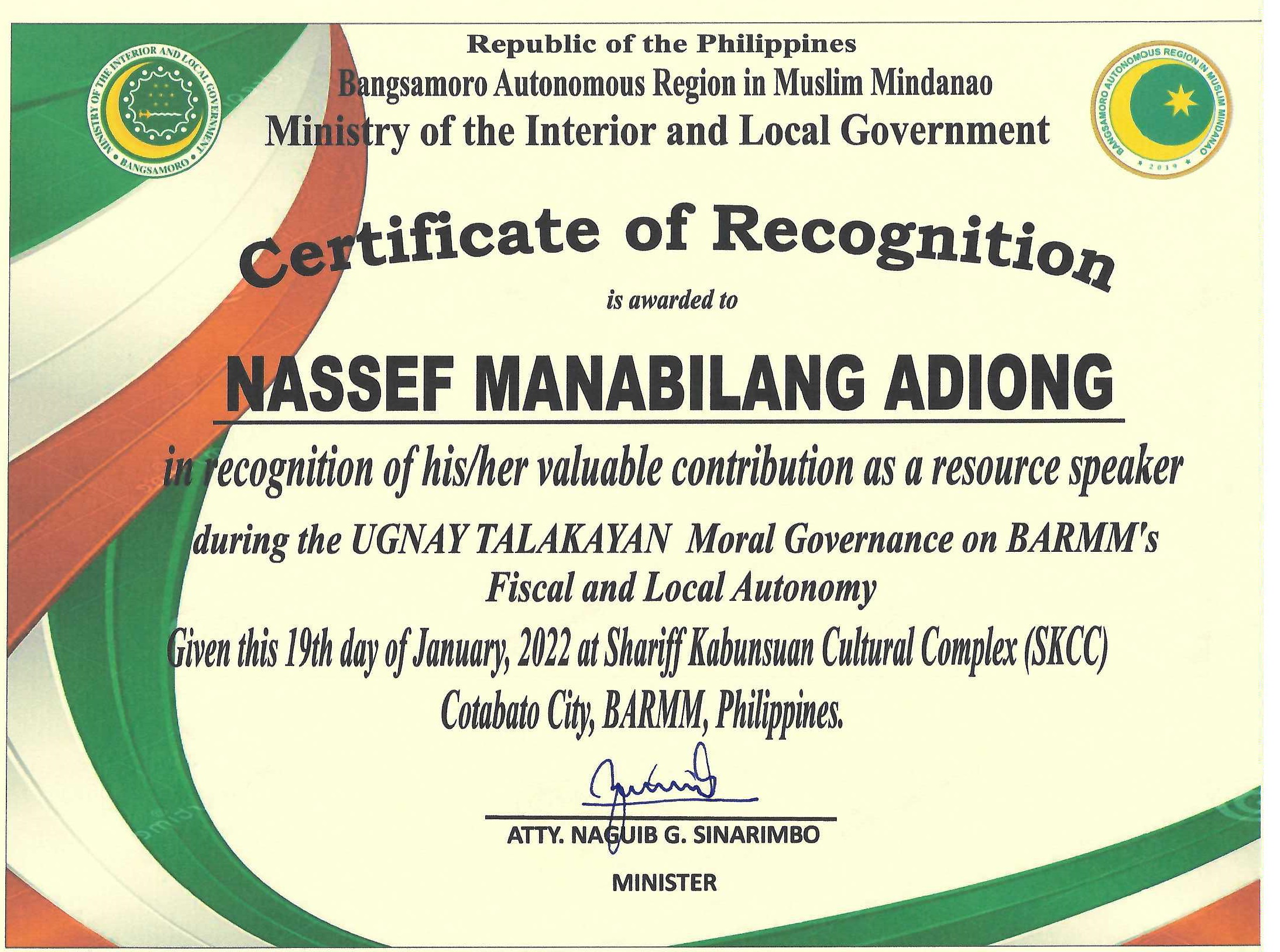
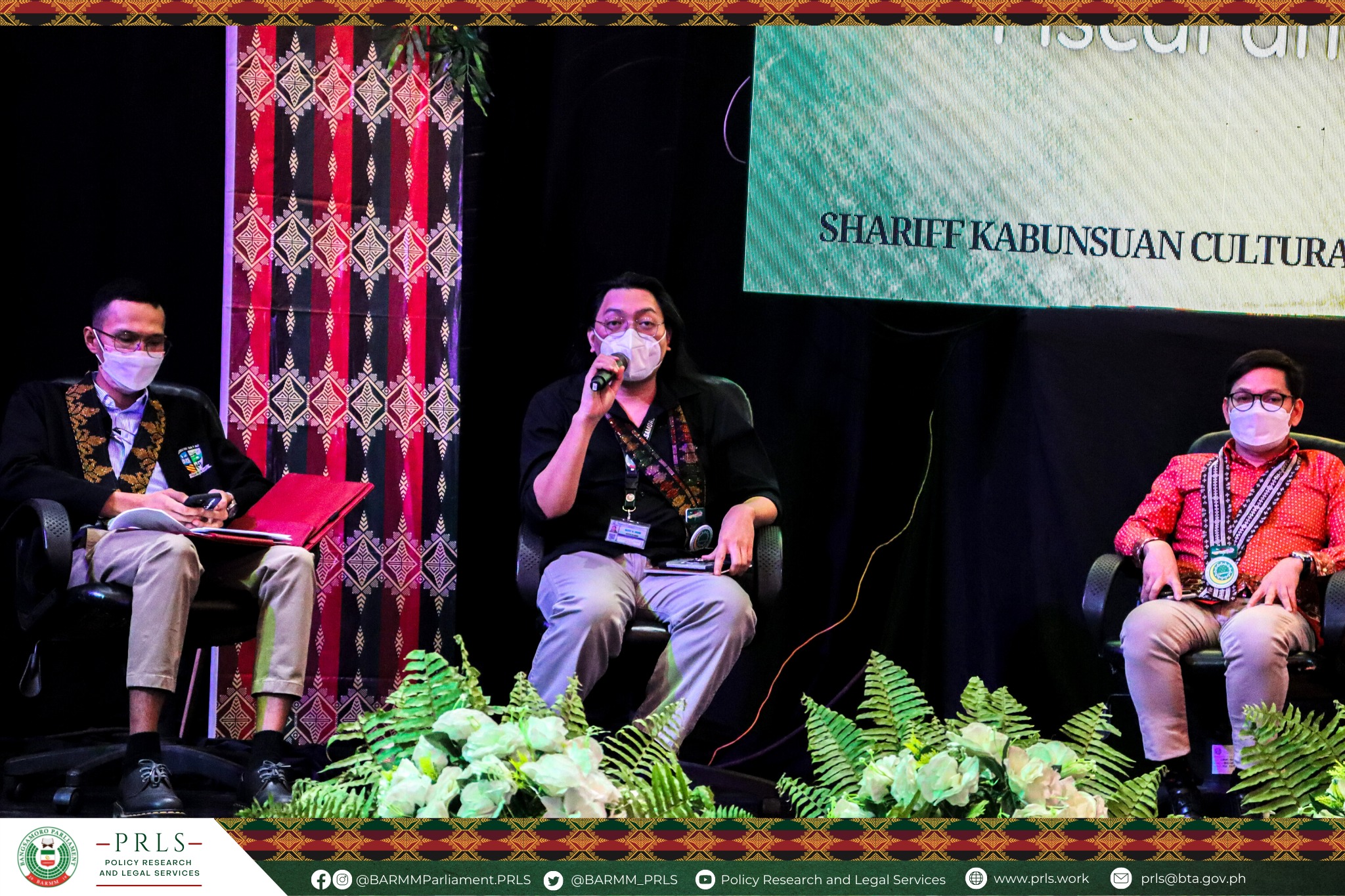
Last January 19, 2022, in celebration of the 3rd founding anniversary of the Bangsamoro government, the Ministry of Interior and Local Government (MILG) in partnership with Policy Research and Legal Services (PLRS), regional local government units (LGUs) regional authorities, and development partners conducted a talk titled: “Ugnay Talakayan: Moral Governance on BARMM’s Fiscal and Local autonomy.” The talk invited the PRLS division heads as expert speakers to tackle the current discourse on LGUs.
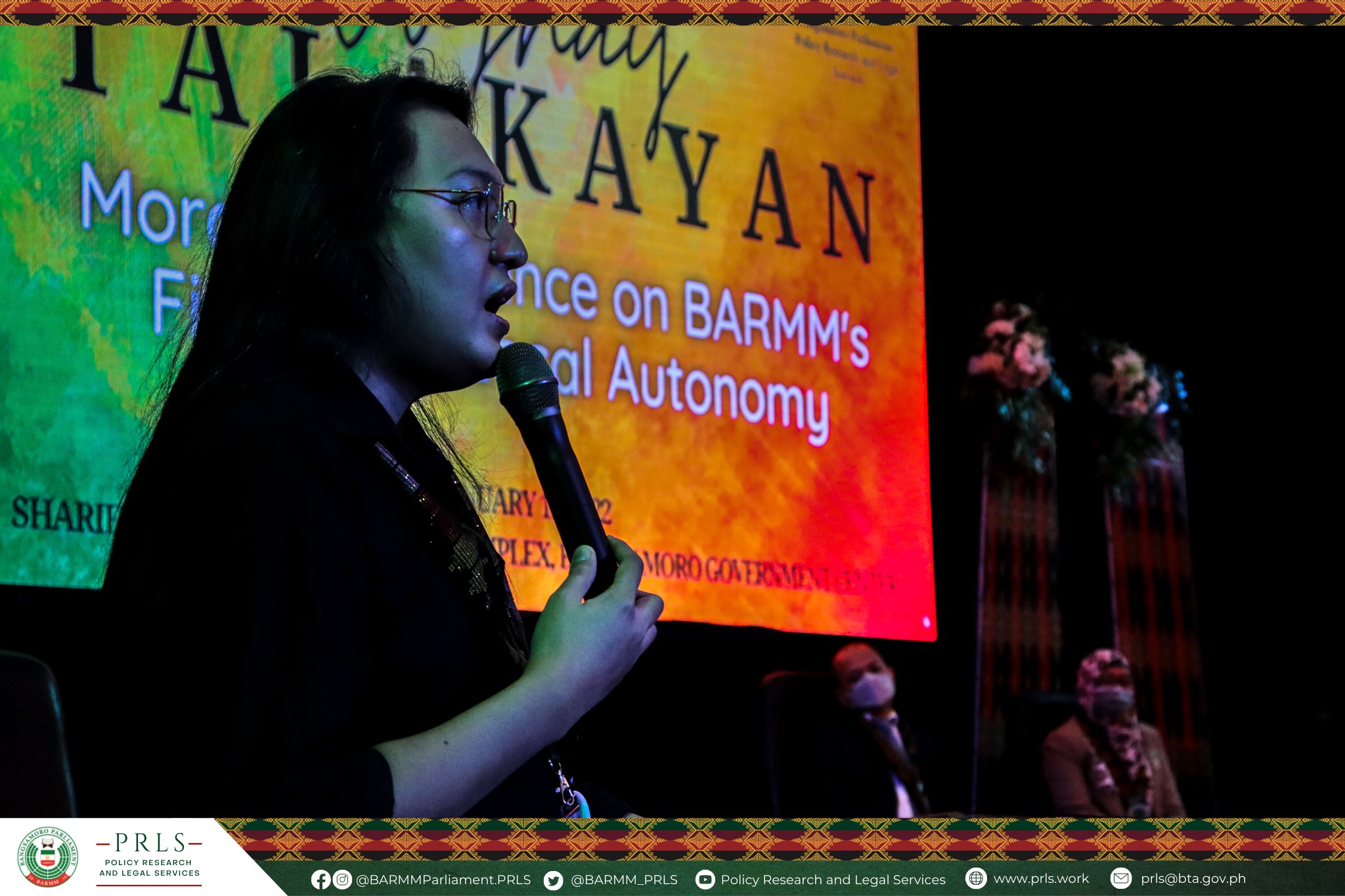
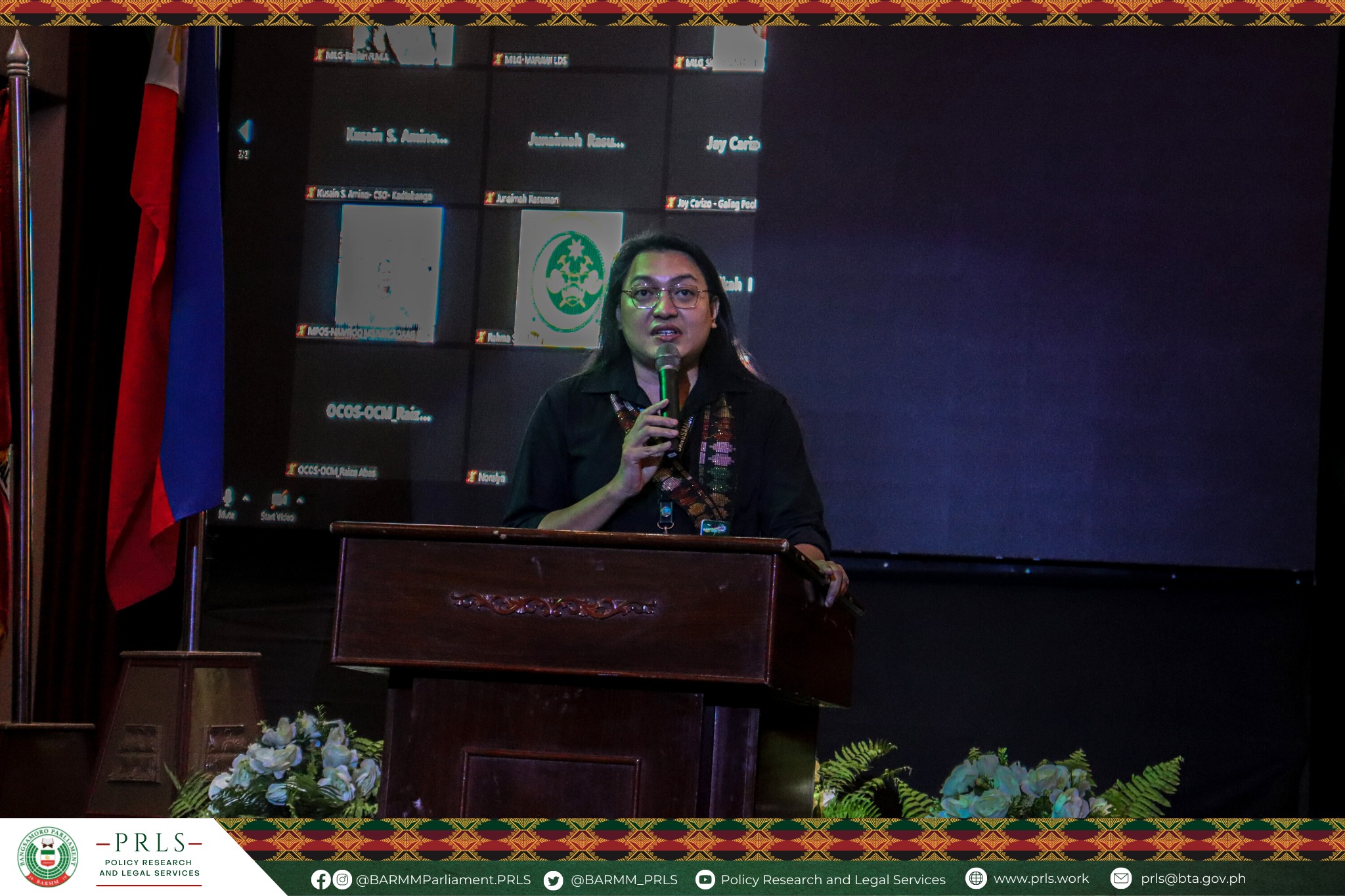
PRLS Director Nassef Manadbilang Adiong, PhD talking about moral governance
On Moral Governance, Dr. Nassef M. Adiong, Director of PRLS, stresses the importance of creating the BARMM’s concept of leadership since our national heroes were greatly influenced by the Western and European concepts of leadership that were adopted by our country. Creating our own Canon of education specifically on the Bangsamoro knowledge production is also vital, being inspired by the first Muslim thinkers during the golden civilization of Islam. He calls for the inclusion of all types of leadership as mandated by Prophet Muhammad’s Charter of Madina—the first documented constitution in the world. Lastly, he highlights the five principles of moral governance which are Faith, Freedom, Moral authority, Common good, and Social Ethics, concerning community, justice, peace, and equality.
On the other hand, Atty. Sha Elijah B. Dumama-Alba, Attorney General of the Attorney general’s office, Office of the Chief Minister, highlights the main objective of Intergovernmental Relations (IGR) i.e. “To designate an important body of activities or interactions occurring between governmental units of all types and levels within the government.” It establishes Processes and Institutions through which the national government (NG) and local government units (LGUs) interact, specifically it settles the relationship between the NG and Bangsamoro Government. Atty. Sha highlights that while it has some given challenges, e.g., the lack of appreciation and awareness of the critical role of IGR, IGR promises inclusive decision making and develops unity in diversity. She further concluded that successful IGR needs strong political will, optimizes formal and informal IGR, empowerment of different social actors, and monitoring of implementation, among others.
As for the current trend on LGUs, Mr. Vincent L. Casil, PRLS’ Legislative and Research Division (LRD) Chief, tackled the effect of Mandanas-Garcia rulings and their implementation to admin regions. As the LGUs budget increases, Mr. Casil noted that devolution of services from the national government to LGUs requires the establishment of accountability and transparency in small units. He explored some of the coupled problems of LGUs devolution of functions, highlighting the lack of clarity in terms of its implementation. Lastly, while the ruling has its positive sides, (e.g. the long effect of its implementation), Mr. Casil concluded by citing “while we need to be an optimist about devolution of LGUs powers and functions, we should also be realistic on what is happening on the ground.”
Finally, Atty. Hisham Naz Ala Biruar, The PRLS Legislative Measures and Legal Assistance Division (LMLAD) Division chief has discussed the Mandanas-Garcia rulings and its inference to BARMM. Atty Hisham has explored the question that arises on the LGUs current trend “What really is the just share of LGUs in the National Government’s budget?” Then he underscored that as the NG implements the Mandanas-Garcia is the Full devolution of LGUs functions. This results in the National Government’s transfer of functions and responsibilities to various LGUs to perform. He concluded that the Mandanas-Garcia ruling cannot be implemented in the BARMM because of three things: the current transition of the BARMM government, the BARMM has its own government code, and the LGUs under the BARMM government are mandated by the Bangsamoro Organic Law.
As panel reactor, Akhmad J. Usman, Regional director DBM SOCCSKSARGEN, however, argued that transfer of functions is not the intention citing “it is not the devolution of functions but to realize the unrealized functions”, rather it is the complementing and/or distributive role of the NG. This includes maximizing the opportunities by empowering LGUs and requiring the LGUs a devolution plan.
On Moral Governance, Dr. Nassef M. Adiong, Director of PRLS, stresses the importance of creating the BARMM’s concept of leadership since our national heroes were greatly influenced by the Western and European concepts of leadership that were adopted by our country. Creating our own Canon of education specifically on the Bangsamoro knowledge production is also vital, being inspired by the first Muslim thinkers during the golden civilization of Islam. He calls for the inclusion of all types of leadership as mandated by Prophet Muhammad’s Charter of Madina—the first documented constitution in the world. Lastly, he highlights the five principles of moral governance which are Faith, Freedom, Moral authority, Common good, and Social Ethics, concerning community, justice, peace, and equality.



 Nassef Manabilang Adiong, PhD
You must be logged in to post a comment.