IMPORTANT UPDATES REGARDING THE INTERNATIONAL CONFERENCE AND ACADEMIC WORKSHOP

In light of the still untenable conditions posed by the Covid-19 global pandemic, the organizers of the International Conference and Academic Workshop “Decolonizing Global Studies: Charting Trends, Mapping Trajectories” have decided to make important decisions. Sensitive to the context of our times yet remaining committed to pursue meaningful academic endeavors, the international conference and academic workshop will be shifting to an online platform with the following adjusted schedule:

The academic workshop will be a one-day event, set on September 10, 2020 (Thursday). The brief morning session will be focused on providing feedback to the accepted papers to be given by the workshop mentors. The afternoon session will have a forum with editors of journals and academic presses to share insights on publishing. 

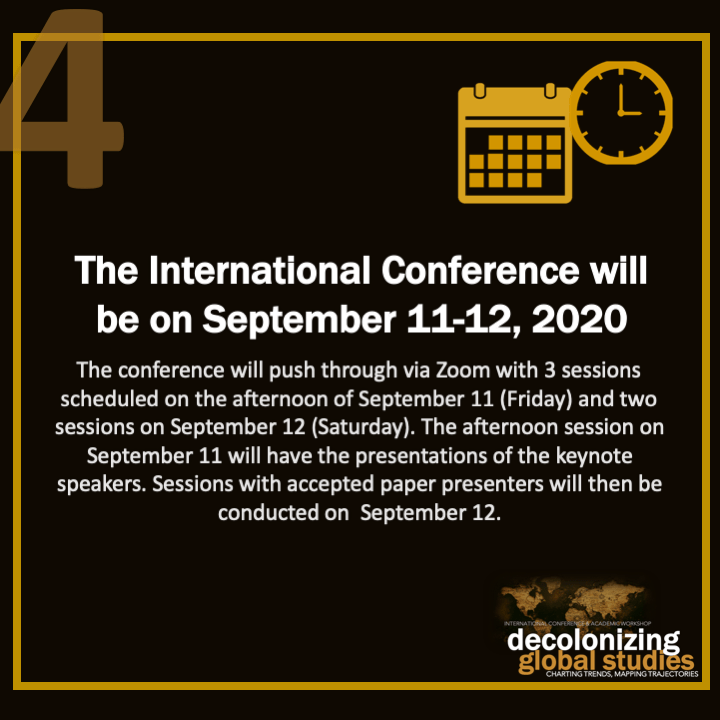
The conference will push through via Zoom with 3 sessions scheduled on the afternoon of September 11 (Friday) and two sessions on September 12 (Saturday). The afternoon session on September 11 will have the presentations of the keynote speakers. Sessions with accepted paper presenters will then be conducted on September 12.

The organizers will continue to accept abstract submissions until July 15, 2020 and submission of full papers for consideration to be included in the workshop would be accepted until July 30. Notices of acceptance will be sent by early August.  

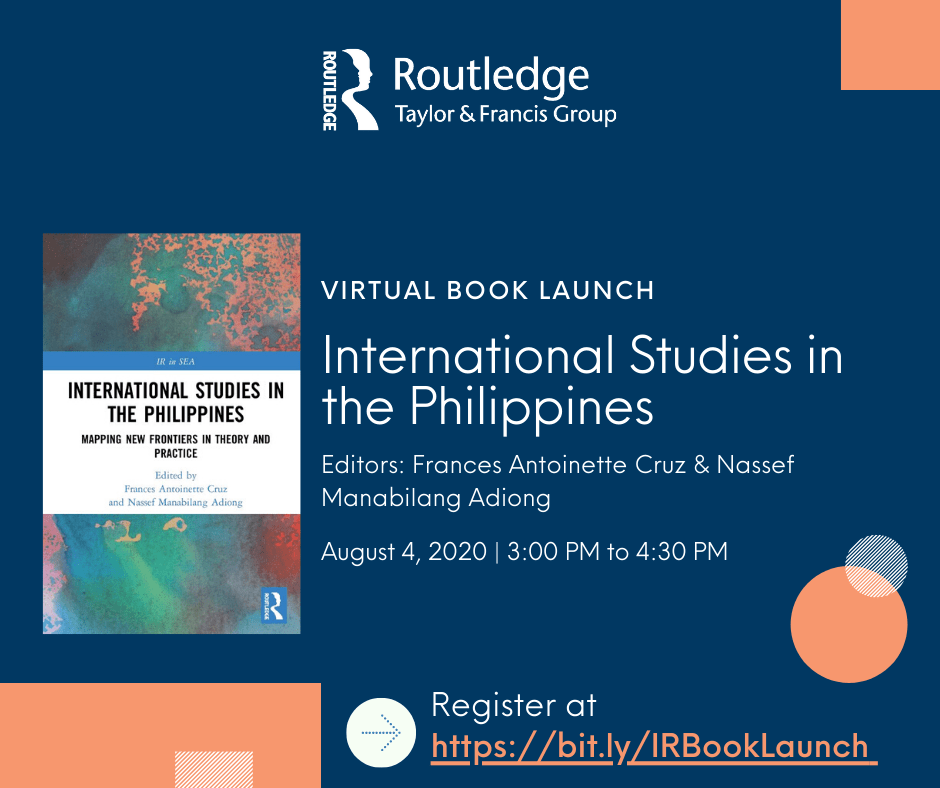
Routledge Virtual Book Launch: International Studies in the Philippines

Join us for a virtual book launch which will map horizons of non-Western approaches in Philippine experiences of International Relations. Click https://bit.ly/IRBookLaunch to register.

About this Event

How can local experiences and the social transformation generated by modernity help to enrich our understanding of the international? What might a version of the much-discussed “non-Western International Relations (IR)” look like? What continuities and discontinuities from the Philippine experience in particular can be useful for understanding other post-colonial polities? The Philippines makes a fascinating case study of a medium-sized, developing, post-colonial, multi-ethnic and multi-cultural state in Southeast Asia.

Program Outline:

Welcome remarks by Taylor & Francis representative

Opening remarks by Rommel A. Curaming (University of Brunei Darussalam)

Introduction by Nassef Manabilang Adiong (University of the Philippines Diliman)

Panel discussion chaired by Frances Antoinette Cruz (University of the Philippines-Diliman)

  • Alan Chong, S. Rajaratnam School of International Studies, NTU, Singapore

Topic: José Rizal Attacks Imperialism Softly: Comprehending the Depths of Psychological Conversion and the Temptations of Violent Solutions

  • Archill Niña Faller-Capistrano, University of the Philippines Cebu

Topic: Sexploitative Human Trafficking In, Out and Beyond the Philippines: A Liquid Problem in a Cosmopolar International System

  • Amador IV Peleo, independent scholar

Topic: Conclusion – Small Statism and the Non-issue of IR in the Philippines

Q&A

Closing remarks by Aigul Kulnazarova (Tama University, Japan)

Registration:

Successful registrants will receive a Microsoft Teams meeting link prior to the event.

Should you have any enquiries, please email us at marketing@tandf.com.sg.

Book review: Islam in international relations. Politics and paradigms

Alice Martini (2019) Islam in international relations. Politics and paradigms, Critical Studies on Terrorism, DOI: 10.1080/17539153.2019.1629726

The relationship between Islam and International Relations has always been a complicated one, but Islam and the Islamic “civilisation” have consistently been objects of interest for the discipline. Nevertheless, the role Islamic theoretical understandings of politics could have in IR is still understudied. Islam in International Relations is a series of works that addresses just this lack. Through it, the editors aim at diversifying the discipline from a specific post-colonial point of view, engaging with International Relations from an “Islamic” approach – broadly defined “as a history, a people, a religion, an intellectual tradition, and the like”. These collective works’ goal is to “offer an expanded and enriched IR that accounts for the diversity of worldviews and perspectives on world affairs”


The Evolution of the Muslim State

The Muslim State in a World of Nation-States
by Nassef Manabilang Adiong

The First International Islamic Governance Symposium:
The Evolution of the Muslim State
September 21-22, 2019
Senate Room, Chancellor Hall, Universiti Brunei Darussalam
https://islamicgovernance.org/iigs/

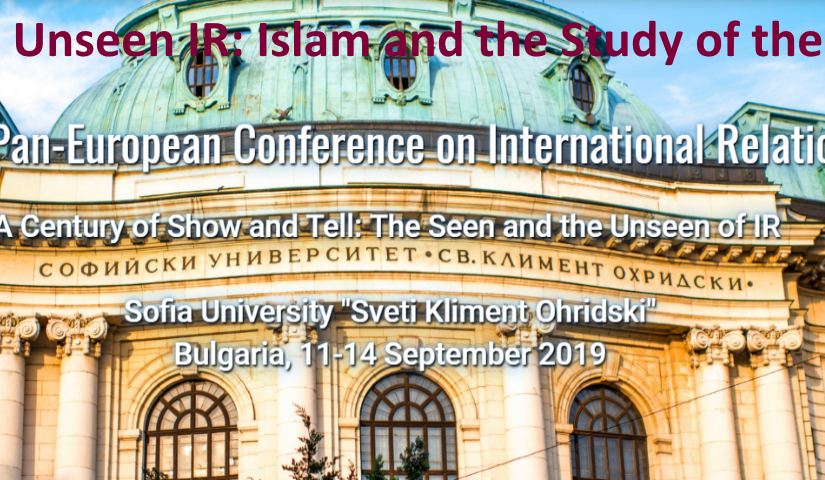
Reminder: “The Unseen IR: Islam and the Study of the ‘International’”

Call for papers and panel proposals for the Co-IRIS section at the 13th Pan-European Conference on International Relations.

Section 44: “The Unseen IR: Islam and the Study of the ‘International’“

Islam has played a major role in world affairs since its inception. Today, the Organisation of the Islamic Cooperation represents the second largest inter-governmental organisation of sates after the UN. A number of Muslim majority countries like the Islamic Republic of Iran, the Republic of Turkey under the AKP, the Kingdom of Saudi Arabia, Pakistan and Malaysia: all claim to follow an Islamic approach to their domestic and foreign policy. Islam as an intellectual force, has received little sustained attention in the fields of Political Science and International Relations specifically. This Section aims to address the nature and goals of international relations, foreign policy and diplomacy from multiple Islamic perspectives. Those perspectives challenge and contribute to international practices and they represent their respective perceptions of the ‘International. The section is an effort to include Islamic civilization and Muslim majority countries in the contemporary international platform and the analysis of the “unseen” in the study of International Relations.

We welcome both individual papers as well as full panel submissions. Proposed panel themes include but are not limited to:
– The seen and unseen in Islamic International Relations Theory
– Islam and international relations
– Islam and Foreign Policy Analysis
– Islam and Diplomacy
– The visual in the international relations of Islamic countries

Deadline for submissions is 28 February 2019. Abstract are to be submitted electronically via the online submission system here, https://www.czech-in.org/cmportalV15/Account/Login?ReturnUrl=%2FcmportalV15%2Fportal%2FPEC19%2Fnormal.

Please, read the Abstract Submission Guidelines prior to making your submission and visit the official EISA PEC 2019 website and the official Co-IRIS website for further updates. Do not hesitate to contact us or the conference organizers with any questions you may have.