Manufacturing Terrorism in Africa: The Securitisation of South African Muslims

The firs book published under the Islam and Global Studies series, a collaborative project between Co-IRIS and Palgrave Macmillan.

Manufacturing Terrorism in Africa: The Securitisation of South African Muslims

Mohamed Natheem Hendricks

234042859This book uses Securitisation Theory to explore how Muslims have been constructed as a security issue in Africa after the 9/11 attacks in the United States. These attacks became the rationale for the US’s Global War on Terror (GWOT). The centrality of Africa as an arena to execute the GWOT is the focus of this book.

This book explores, particularly, how western-centred security discourses around Muslims has permeated South African security discourse in the post-apartheid period. It claims that the popular press and the local think-tank community were critical knowledge-sites that imported rather than interrogated debates which have underpinned policy-initiatives such as the GWOT.

Such theorisation seems contrary to the original architects of securitisation theory who maintain that issues become security concerns when institutional voices declare these as such. However, this book confirms that non-institutional voices have securitised the African Muslims by equating them with terrorism.

This book illustrates that such securitisation reproduces partisan knowledge that promote Western interests.


Dr Mohamed Natheem Hendricks, Senior Lecturer, Faculty of Education, University of the Western Cape, Cape Town, South Africa. His interest in security matters was sparked by debates related to Regional, Water and Human Security.

IMPORTANT UPDATES REGARDING THE INTERNATIONAL CONFERENCE AND ACADEMIC WORKSHOP

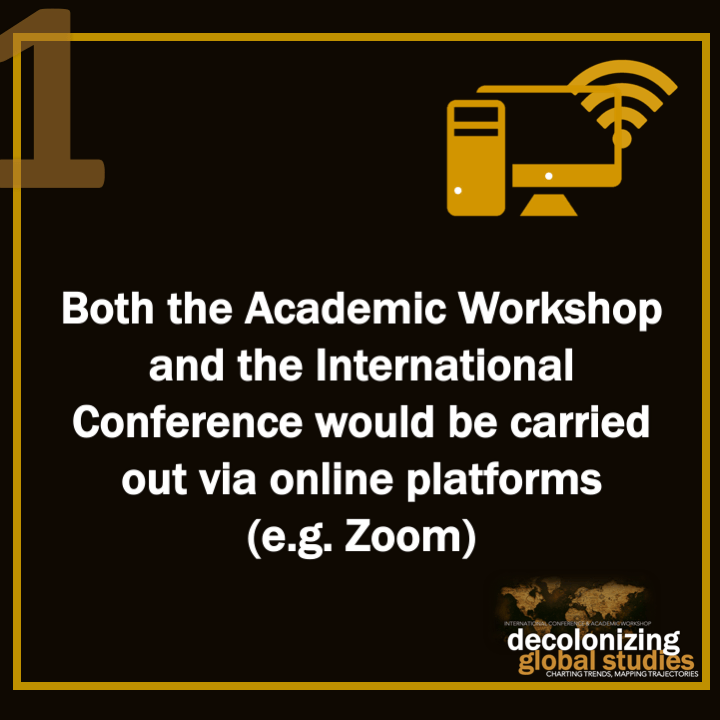
In light of the still untenable conditions posed by the Covid-19 global pandemic, the organizers of the International Conference and Academic Workshop “Decolonizing Global Studies: Charting Trends, Mapping Trajectories” have decided to make important decisions. Sensitive to the context of our times yet remaining committed to pursue meaningful academic endeavors, the international conference and academic workshop will be shifting to an online platform with the following adjusted schedule:

The academic workshop will be a one-day event, set on September 10, 2020 (Thursday). The brief morning session will be focused on providing feedback to the accepted papers to be given by the workshop mentors. The afternoon session will have a forum with editors of journals and academic presses to share insights on publishing. 

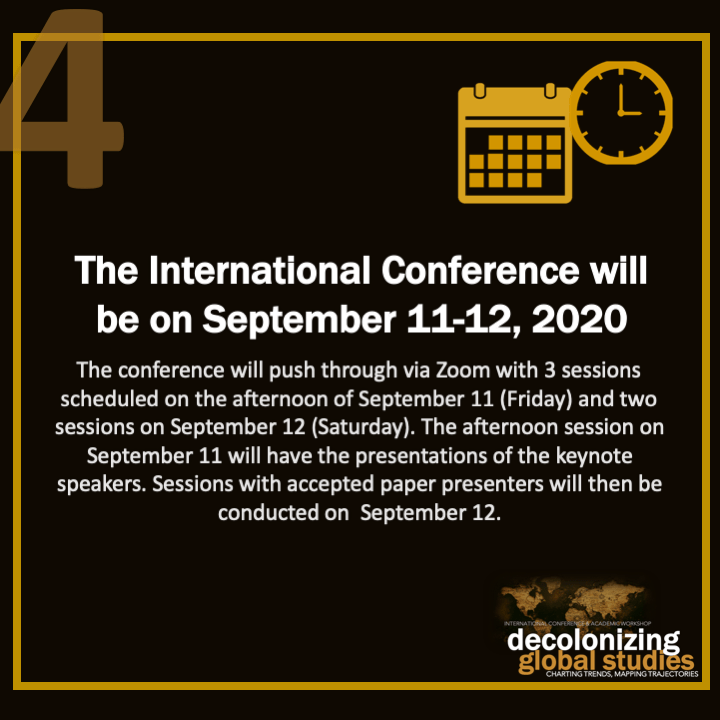
The conference will push through via Zoom with 3 sessions scheduled on the afternoon of September 11 (Friday) and two sessions on September 12 (Saturday). The afternoon session on September 11 will have the presentations of the keynote speakers. Sessions with accepted paper presenters will then be conducted on September 12.

The organizers will continue to accept abstract submissions until July 15, 2020 and submission of full papers for consideration to be included in the workshop would be accepted until July 30. Notices of acceptance will be sent by early August.  


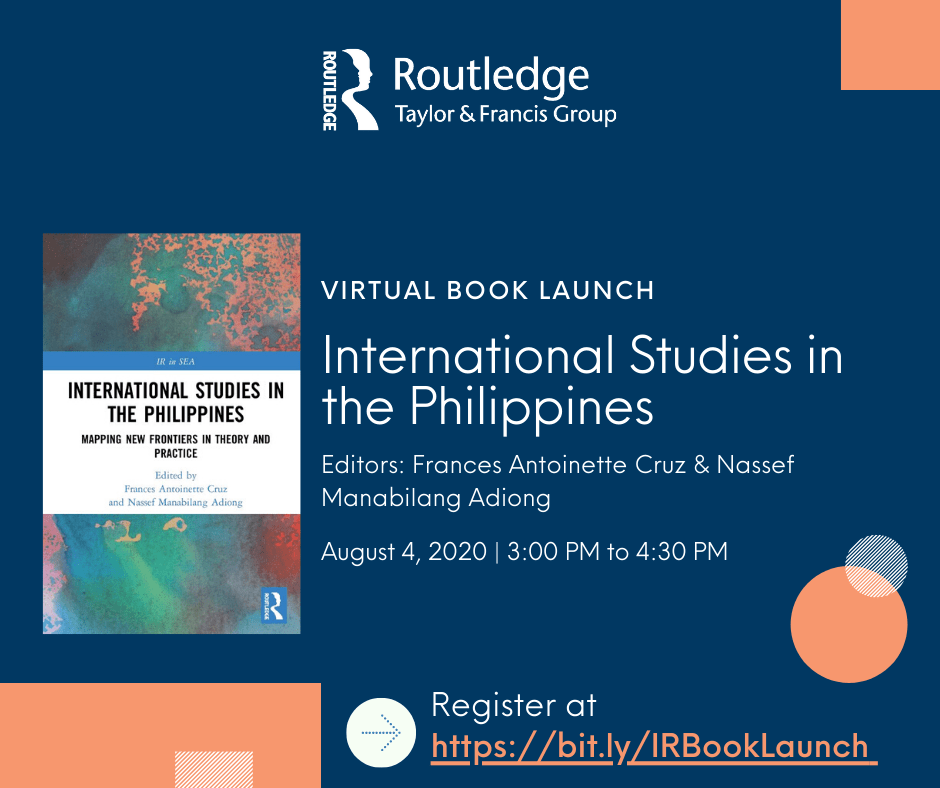
Routledge Virtual Book Launch: International Studies in the Philippines

Join us for a virtual book launch which will map horizons of non-Western approaches in Philippine experiences of International Relations. Click https://bit.ly/IRBookLaunch to register.

About this Event

How can local experiences and the social transformation generated by modernity help to enrich our understanding of the international? What might a version of the much-discussed “non-Western International Relations (IR)” look like? What continuities and discontinuities from the Philippine experience in particular can be useful for understanding other post-colonial polities? The Philippines makes a fascinating case study of a medium-sized, developing, post-colonial, multi-ethnic and multi-cultural state in Southeast Asia.

Program Outline:

Welcome remarks by Taylor & Francis representative

Opening remarks by Rommel A. Curaming (University of Brunei Darussalam)

Introduction by Nassef Manabilang Adiong (University of the Philippines Diliman)

Panel discussion chaired by Frances Antoinette Cruz (University of the Philippines-Diliman)

  • Alan Chong, S. Rajaratnam School of International Studies, NTU, Singapore

Topic: José Rizal Attacks Imperialism Softly: Comprehending the Depths of Psychological Conversion and the Temptations of Violent Solutions

  • Archill Niña Faller-Capistrano, University of the Philippines Cebu

Topic: Sexploitative Human Trafficking In, Out and Beyond the Philippines: A Liquid Problem in a Cosmopolar International System

  • Amador IV Peleo, independent scholar

Topic: Conclusion – Small Statism and the Non-issue of IR in the Philippines

Q&A

Closing remarks by Aigul Kulnazarova (Tama University, Japan)

Registration:

Successful registrants will receive a Microsoft Teams meeting link prior to the event.

Should you have any enquiries, please email us at marketing@tandf.com.sg.

Book review: Islam in international relations. Politics and paradigms

Alice Martini (2019) Islam in international relations. Politics and paradigms, Critical Studies on Terrorism, DOI: 10.1080/17539153.2019.1629726

The relationship between Islam and International Relations has always been a complicated one, but Islam and the Islamic “civilisation” have consistently been objects of interest for the discipline. Nevertheless, the role Islamic theoretical understandings of politics could have in IR is still understudied. Islam in International Relations is a series of works that addresses just this lack. Through it, the editors aim at diversifying the discipline from a specific post-colonial point of view, engaging with International Relations from an “Islamic” approach – broadly defined “as a history, a people, a religion, an intellectual tradition, and the like”. These collective works’ goal is to “offer an expanded and enriched IR that accounts for the diversity of worldviews and perspectives on world affairs”


The Evolution of the Muslim State

The Muslim State in a World of Nation-States
by Nassef Manabilang Adiong

The First International Islamic Governance Symposium:
The Evolution of the Muslim State
September 21-22, 2019
Senate Room, Chancellor Hall, Universiti Brunei Darussalam
https://islamicgovernance.org/iigs/