Nassef is the founder of PHISO (Philippine International Studies Organization), BRLN (Bangsamoro Research and Legal Network), DSRN (Decolonial Studies Research Network), and Co-IRIS (International Relations and Islamic Studies Research Cohort). He researches policy issues affecting the Bangsamoro society and explores decolonial knowledge sources of the global south as well as interdisciplinary study between Islam and International Relations.
Author: Nassef Manabilang Adiong
Nassef is the founder of Co-IRIS (International Relations and Islamic Studies Research Cohort), PHISO (Philippine International Studies Organization), DSRN (Decolonial Studies Research Network), and BRLN (Bangsamoro Research and Legal Network). He works on interdisciplinary research between Islam and International Relations and explores the Bangsamoro society as he heads the Policy Research and Legal Services (PRLS) of the Bangsamoro Parliament. Visit https://nassef.info/ for more details.
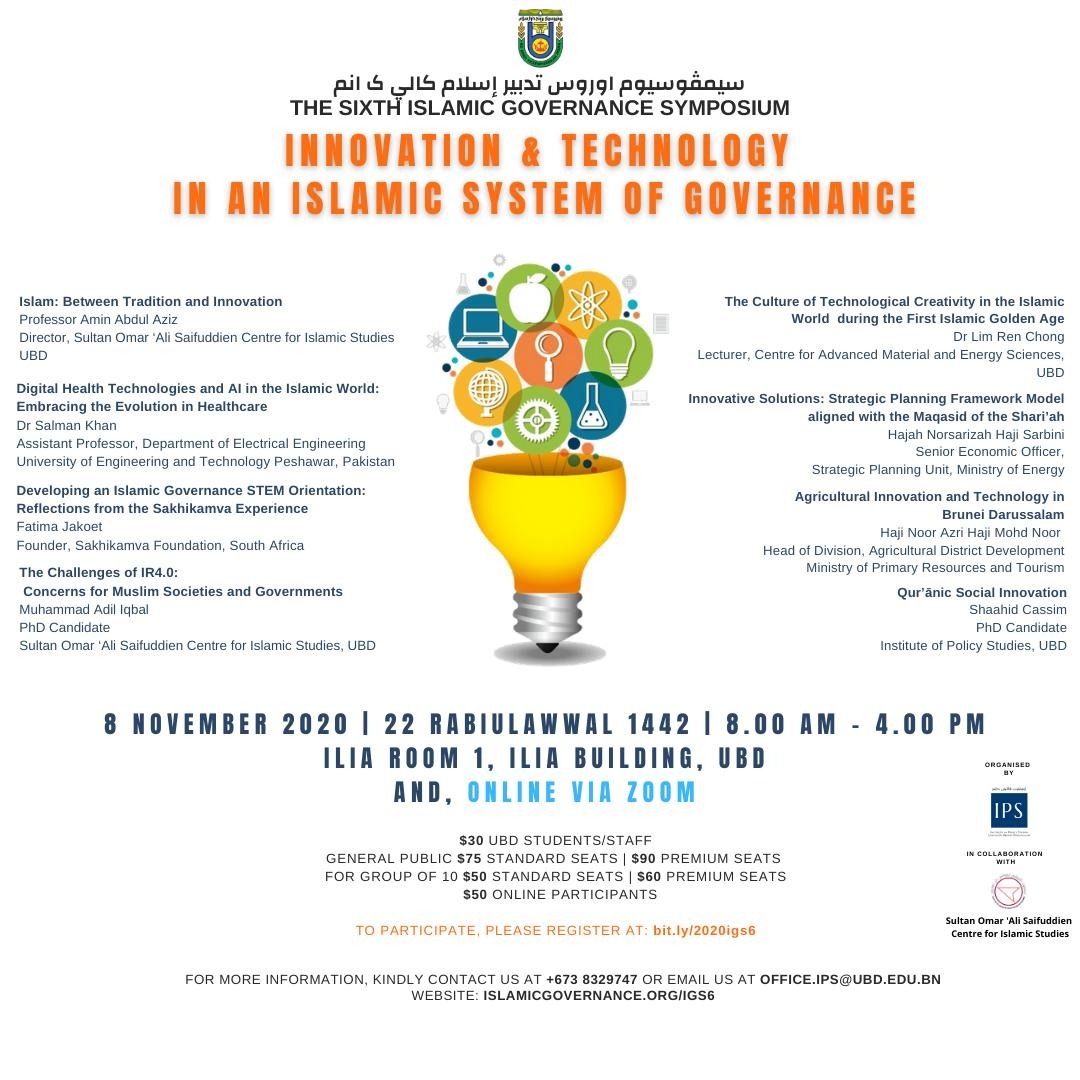
You are cordially invited to attend the 6th Islamic Governance Symposium with the theme, “Innovation and Technology in an Islamic System of Governance,” organized by the UBD Institute of Policy Studies and in collaboration with the Institute for Leadership, Innovation, and Advancement (ILIA) and with the Sultan Omar ‘Ali Saifuddien Centre for Islamic Studies.
The event will be held on November 08, 2020 from 8:00am to 4:00pm at ILIA Room 1, ILIA building of the University of Brunei Darussalam (UBD). Click here to register.
For more information, kindly contact +673.832.9747 or email office.ips@ubd.edu.bn. Thank you.
We are delighted to announce the result of the essay competition for the PHISO book, “International Studies in the Philippines.” After a careful review and deliberation of all 16 submissions, the board of judges has decided to award the following individuals:
1st best essay winner: Xylene Buenvenida Tandoc, Benguet
2nd best essay winner: John Leihmar Centeno Toledo, Laguna
3rd best essay winner: Shania Ashley Masucol Dejarme, Misamis Oriental
The winners will receive a hardcover copy of the book. Please take note that the result decided by the board of judges is strictly unappealable. Congratulations to the winners and special thanks to those who participated in the essay competition.
Hello everyone! As part of the activities we are preparing with the conference “Decolonizing Global Studies: Charting Trends, Mapping Trajectories,” we are also having a Special Session and Conversation with Academic Publishers and Academic Journal Editors this September 10, 2020, 1:00-4:30 PM. We asked our panelists to share something about the respective publishing house/press they are part and academic journals they are editing; share insights and tips for those who wish to publish their papers. Maybe we can also ask them about their experience and adjustment during this context of the global pandemic. Exciting discussions ahead, right?
Those who will be notified with the Zoom credentials for the conference will also receive the Zoom credentials for this special session.
Adiong, N.M. (2020) “Muslim Governance and Salafi Orthodoxy.” In: R.J.G. Ong, ed., Security Sector Reform and Governance in the Philippines. National Defense College of the Philippines and Security Reform Initiative, Inc., pp. 131-153.
The spread of Salafi orthodoxy (also known as the Wahabi-Salafi-Jihadist creed or sometimes shortened, Salafism) changed the dynamics of present-day believing Muslims. Using petro-dollars to build mosques, disseminate unscholarly translations of Qur’an and hadiths, and provide bursaries to Muslim Filipinos to learn Salafi orthodoxy in the Middle East, particularly in Saudi Arabia, lead to the disturbance of pre-1960s polyphony of Islamicate cultures in the region. From forbidding Christmas greetings, wearing Saudi/Arab-styled clothing, banning certain music, disenfranchising women to treating non-Muslims (even Muslims that do not subscribe to Salafi orthodoxy) as enemies of the religion. It raises the pertinent question of how, in just over a half century, Salafi orthodoxy penetrated Moro’s multicultural traditions. The article started addressing Muslim perspectives on authority and territoriality as imperative components of an ideal Muslim governance. Despite these ideal notions in Muslim history, the last section presented an aberrant ideology that had supplanted historical views on authority and territoriality. Salafi orthodoxy became the dominant political theology which had affected the security of contemporary Muslim Filipinos.
DECOLONIZE EVERYTHING!: Filipinos on the future of global development, health, human rights and peace Date: 10 August, 1pm UK time / 8pm Philippines time / 6am US East Coast time
A global pandemic and mass protests all over the world – against all sorts of oppression, from racism in the Global North to authoritarianism in the Global South – has forced many of us into collective soul-searching of what our futures could look like. Four Filipinos who have experience working globally on issues that matter for the world as well as their own country offer their reflections on decolonizing our futures: in global development, health, human rights and peace. In Tagalog, “kwentuhan” means to tell each other stories, often in a lively fashion, where voices overlap and narratives interweave. Join us in this informal, irreverent kwentuhan, where we share stories from our personal and professional lives.
Click the video above.
Speakers: Arbie Baguios is an international development and humanitarian aid professional, having worked for international organisations including ActionAid, Save the Children, UNICEF and the Red Cross. He is the founder of Aid Re-imagined, an initiative that helps usher the evolution of the aid sector towards justice and effectiveness.
Renzo Guinto is a public health physician working at the nexus of global health and sustainable development. He is the Chief Planetary Doctor of PH Lab, a glo-cal think-and-do tank for people and the planet, and has consulted for various organizations including the World Bank, World Health Organization, International Organization for Migration, and Philippine Department of Health.
Ross Tugade is a lawyer with the Commission on Human Rights, the constitutionally-created national human rights institution of the Philippines. She is also a published writer and researcher on the topics of human rights law and transitional justice.
Reg Guevara is a practitioner of regional peace and security, especially as it concerns ASEAN, and the Jewish-Arab conflict. Professionally, Regine has worked with multilateral institutions such as USAID, ASEAN, UN Women, UN Habitat, UNESCO, but is happier than ever working at the regional level for her peace advocacies with South-South Cooperation Council. Having lived in different cities around the world, she takes comfort in the mystic Rumi’s saying: “If light is in your heart, you will find your way home.”
Moderator: Frances Antoinette Cruz is Assistant Professor at the College of Arts and Letters, University of the Philippines, Diliman, and co-convenor of the Decolonial Studies Program at the UP Center for Integrative and Development Studies.
You must be logged in to post a comment.