“Philippine orientalism and Bangsamoro’s decolonial responses: how othering of others perpetuates” at Doha conference on Orientalism

With the purpose of ‘in aid of legislation,’ Dir. Dr Adiong’s research presentation focuses on two accounts: one is how Bangsamoro became an orientalist object targeted and subjected to Christian Filipino’s political elites’ ploy while the second is marked by political responses that the Muslim Moros partake in utilizing morality and decoloniality as their defensive neo-orientalist cards through a strategic regional legislation mechanism of their reputed autonomous parliament.
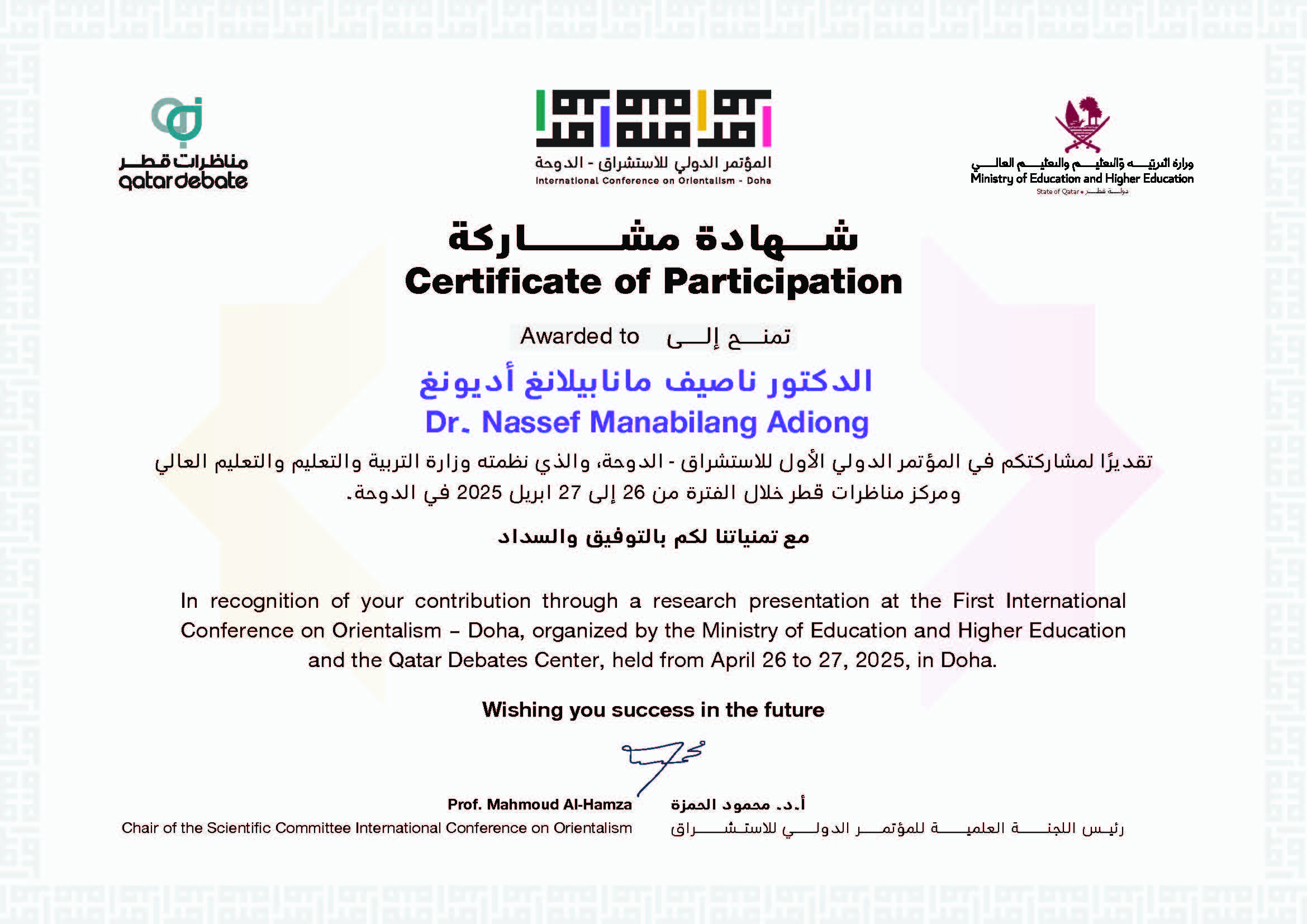
The research presentation, through conference network platforms, can shed light and provide legislative support to the following pending bills, namely, Bill no. 309 or protection of rights and welfare of community settlers, Bill no. 299 or Bangsamoro history towards autonomy museum, and Bill no. 31 or Bangsamoro Regional Institute for Higher Islamic Studies. It is without a doubt that this office supports Dir. Dr Adiong’s policy research endeavors in uplifting Bangsamoro lives through sound legislative advocacy by endorsing his request to participate in the Doha conference and gather data in aid of legislation.

Unbeknownst to a usual doxa rhetoric, Philippines is not a homogenous nation-state characterized by cultural or normative uniformity unlike their Asian counterparts of Malays, Chinese, Japanese, Koreans, and Thai descents who shared similitude of cultural traits, physical attributes, or civilizational values. Filipinos are culturally diverse with more than 195 spoken languages, 182 ethnolinguistic communities, majority (or 86% of its demography) are affiliated with the Christian faith represented by various Catholic and Protestant groups while a significant Muslim population exists in Southern Philippines alongside indigenous peoples (IPs) who settled across the country (Ileto 2001). There is a deep sense of favoring colonial experiences by Filipinos living in urban cities such as in Metro Manila, Cebu, or Davao as they have embraced Christianity from Spain and emulated the educational system, form of government, and whiteness culture of the US (Curaming 2009; Perez 2023). This “coloniality of being,” palpable and arguably claimed to be unique by those Christian Filipino urban dwellers, is the one thing that many Muslim Filipinos—particularly the Moro peoples—and IPs been struggling to accept and thus hereby resent until today (Alegre 2015; Mendoza 2023; Valencia 2022).

Borne from its self-conscious social and Islamic identity as Bangsamoro, these communities are composed of 13 ethnolinguistic Muslim groups where Meranaw, Maguindanaon, and Tausug dominate the entire representation. A cultural collectivity resulting from a struggle for self-rule and self-determination is deeply rooted in the historicity of the Muslims in the Philippines. Creating and organizing political representation is an orientalist strategy by Christian Filipinos’ political elites to address the age-old “Moro Problem,” also known as the “Mindanao Problem” or “Mindanao Conflict,” and purportedly gain peace dividends and capitalistic development. But the Bangsamoro response upends a certain decolonial dive of morality in which they called it “moral governance,” a process that denotes a system of order that is values-based and Islamically rooted. Islamic ethical philosophy is foundational to the Bangsamoro leadership framework that encompasses five immutable principles: Faith, Freedom, Moral Authority, Common Good, and Social Ethics (Adiong 2021).

Aside from the morality card as a response to Christian Filipino’s orientalist views and portrayals of Muslims in the Bangsamoro, the decolonial card is another response stemming from addressing colonial historical injustices by carving its own political trajectory through autonomy and resisting the replication of colonial-based politics. The discussion focuses on two accounts, one is how Bangsamoro became an orientalist object targeted and subjected to Christian Filipino’s political elites’ ploy and the second one is marked by political responses that the Muslim Moros partake in utilizing morality and decoloniality as their defensive neo-orientalist cards. And one approach that the Bangsamoro used is through regional legislation of their own autonomous parliament. 

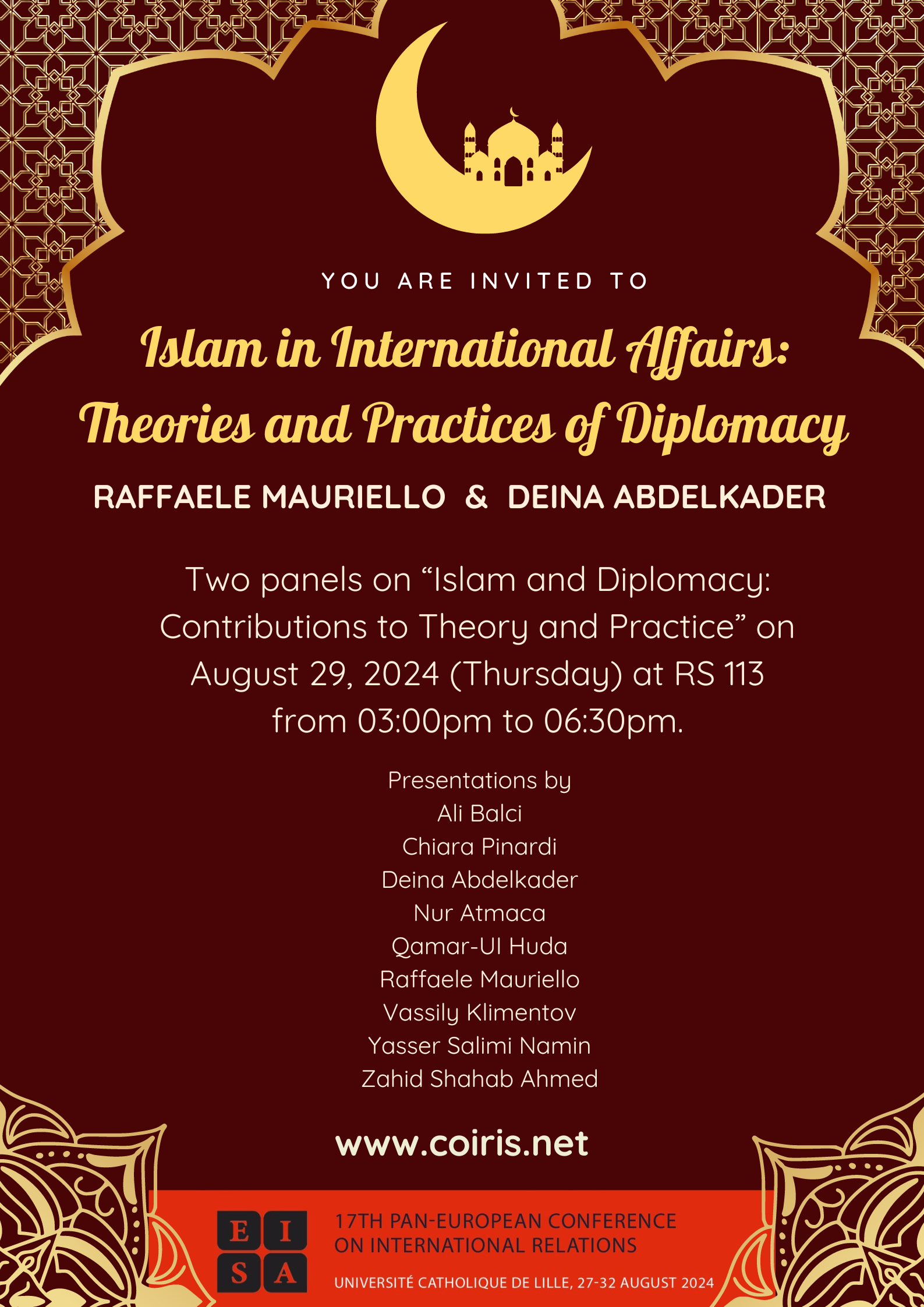
Islam in International Affairs: Theories and Practices of Diplomacy

You are invited to attend the two panels on “Islam and Diplomacy: Contributions to Theory and Practice” on August 29, 2024 (Thursday) at RS 113 from 03:00pm to 06:30pm.

Organized by Raffaele Mauriello and Deina Abdelkader of section 13 on “Islam in International Affairs: Theories and Practices of Diplomacy” hosted by the European International Studies Association (EISA) for the 17th Pan-European Conference on International Relations.

Islam and International Relations (IR): why is there no Islamic IR theory? by Ali Bakir

International Relations (IR) as an academic discipline is relatively new and almost entirely dominated by Western sources of knowledge. Its biased nature undermines its capacity to understand, explain and predict events in the non-Western part of the world. With the increasing effort to explore non-Western IR and diversify the sources of knowledge of the discipline, Islam has emerged as an essential source of interest, not necessarily as a reflection of the East–West dichotomy or non-Western versus Western discourse, but rather as an approach that has its own rules, concepts and perspectives on IR. In this sense, the article contributes to the increasing discussions on the interaction between Islam and IR. It critically engages with three levels of discourse: first, IR in Islam; second, Islam in contemporary IR; and, third, Islam as an IR theory or as a paradigm. The paper attempts to address the question of why there are no modern Islamic IR theories by exploring reasons related to Muslims as well as to the nature of the current system and Western hegemony. It concludes by introducing an initial model and two paths (traditional and revolutionary) that might help mitigate this situation in the future.

To download the article, click here.

Decolonial Approaches to Legislation Seminar-Workshop


This is a 2-day seminar-workshop organized by the UP-CIDS Decolonial Studies Program, the Bangsamoro Parliament’s Policy Research and Legal Services (PRLS), and the Decolonial Studies Research Network (DSRN). This aims to explore, discuss, and elaborate the usage of decolonial approaches in crafting legislative measures such as bills and resolutions in the Bangsamoro Parliament. It shall illustrate the importance of decoloniality in the lived-experiences and socio-cultural realities of the Moro peoples vis-à-vis the world of policymaking and implementation.

The deadline for registration is on November 11th, 2022. This event will be held in person in Cotabato City, Philippines.

Register here or use the shortened URL bit.ly/decolonial-legislation.

Call for Abstracts: Social and Political Suffocations

About the book
Building on the understanding that the unequal distribution of wealth, privilege,
infrastructures, social and political agency and recognition take place along intersectional
power dynamics, this edited volume asks how these power dynamics operate in constituting
whose lives, and what life forms, are un/breathable. By approaching this topic as an
entanglement of structural, individual and quotidian operations of biopolitics and
necropolitics, this edited volume will offer critical analyses and transformative interventions
that can be developed to understand and challenge the suffocating and unliveable
atmospheres of contemporary ways of existing. It will address experiences of social and
political suffocations, as well as concomitant strategies of resistance, through chapters
written by an interdisciplinary assembly of scholars, artists, and activists who are all
embodied practitioners in their critical practice(s).

Formats and deadlines
Please submit your abstracts (approximately 300 words) along with:

  1. A short bio of approximately 150 words
  2. A title of the proposed chapter
  3. An indication of which inhalation, exhalation, or stop your work relates to

Please do not hesitate to submit work that addresses social and political suffocations even if
it does not fit exactly our preliminary outline of the book or the themes discussed in this
call.

Please send your abstract and accompanying information to Tobin den Blijker:
t.r.denblijker@students.uu.nl.
The abstract deadline is: Friday December 3, 2021. The expected publication date is at the end of 2022 and the edited volume will be part of the
Routledge Critical Perspectives on Breath and Breathing book series edited by Lenart Škof
and Magdalena Górska.

PLEASE FIND THE COMPLETE CALL FOR ABSTRACTS HERE.