First issue of IJIA is out now!

Volume 1 (2020): Issue 1 (Dec 2020) in International Journal of Islam in Asia

The establishment of the International Journal of Islam in Asia (IJIA) aims to offer an academic platform for all aspects of research on Islam in Asia, particularly to shed light on understudied Muslim communities. The original intent of creating the journal was to promote scholarly endeavors and research works concentrating on the study of Islam and Muslim societies in Southeast Asia. The region was, and still is, sadly referred to as the periphery of the Muslim world even though it has one of the largest Muslim populations in the world. The Muslim Southeast Asian region manifests a sheer unparalleled diversity of cultures, traditions and mores which have survived for centuries despite the influence of Western modernity, coloniality, and the ascendance of the nation-state system. Through careful and long deliberation among us, the editors, and the publisher, it was decided to expand the regional scope of IJIA to cover the entire Asia and accommodate diverse epistemic backgrounds that could go beyond disciplinary boundaries.

Aside from academic articles, the journal will aim to include policy research that comprises historical and contemporary Muslim communities in Asia and the Asian Muslim diaspora. The journal also aims to cover an eclectic group of articles that vary in their topics such as but not limited to, theoretical, methodological, empirical, religious, spiritual, and critical studies of Islam, including mundane praxes and lived Islam. It is interesting to explore Islamic theories and how they fit or (dis)connected to the ground realities of Muslims’ everyday lives. Moreover, it is necessary to analyze the critical variations of Islamic views when we speak about belief, faith, credence, truth, religion, religious, religiosity, spiritual, and spirituality.

The editors encourage multi-, inter- and transdisciplinarity and eclectic contributions from both scholars and practitioners (e.g. preachers, spiritual/religious leaders, and policy makers) to facilitate a holistic approach towards the study of Islam and of Muslim societies in the entire continent. Although we welcome all research backgrounds and knowledge orientations, for example, a decolonial lens on Islam, we are particularly interested to receive submissions that are relevant to MENA-Asia relations, Islamic thought and intellectual history, Islamic philosophy, intra-Muslim (Sunni and Shi’i) relations, Sufism, canonical and periphery Islam, Islam and ethnicity, Islam and modernity, Islam and politics, Islam and the State, Islam and geopolitics, Islamic Studies and Area Studies, and relations between Muslims and non-Muslims across Asia.

Introduction
Authors: Nassef Manabilang Adiong, Deina Abdelkader, and Raffaele Mauriello

Sinicizing Islam: Translating the Gulistan of Saʿdi in Modern China
Authors: Alexander Jabbari and Tiffany Yun-Chu Tsai

Islamic Feminism and Hegemonic Discourses on Faith and Gender in Islam
Author: Farah Shahin

Buddhism according to Modern Muslim Exegetes
Authors: Ahmad Faizuddin Ramli, Jaffary Awang, and Zaizul Ab Rahman

Religious Tolerance of Madrasa Students according to Their Religious Affiliation: An Empirical Investigation
Authors: Sadia Shaukat and Anthony William Pell

The Defence of National Identity as a Revolutionary Concept: Gharbzadigī, Islamic Modernisation, and Anticolonialism
Author: Alessia Tortolini

Three best essays: “How and in what ways Filipinos can decolonize knowledge?”

We are delighted to announce the result of the essay competition for the PHISO book, “International Studies in the Philippines.” After a careful review and deliberation of all 16 submissions, the board of judges has decided to award the following individuals:

1st best essay winner: Xylene Buenvenida Tandoc, Benguet

2nd best essay winner: John Leihmar Centeno Toledo, Laguna

3rd best essay winner: Shania Ashley Masucol Dejarme, Misamis Oriental

Click here to read Tandoc’s winning essay.

Click here to read Toledo’s winning essay.

Click here to read Dejarme’s winning essay.

The winners will receive a hardcover copy of the book. Please take note that the result decided by the board of judges is strictly unappealable. Congratulations to the winners and special thanks to those who participated in the essay competition.

Publication Forum

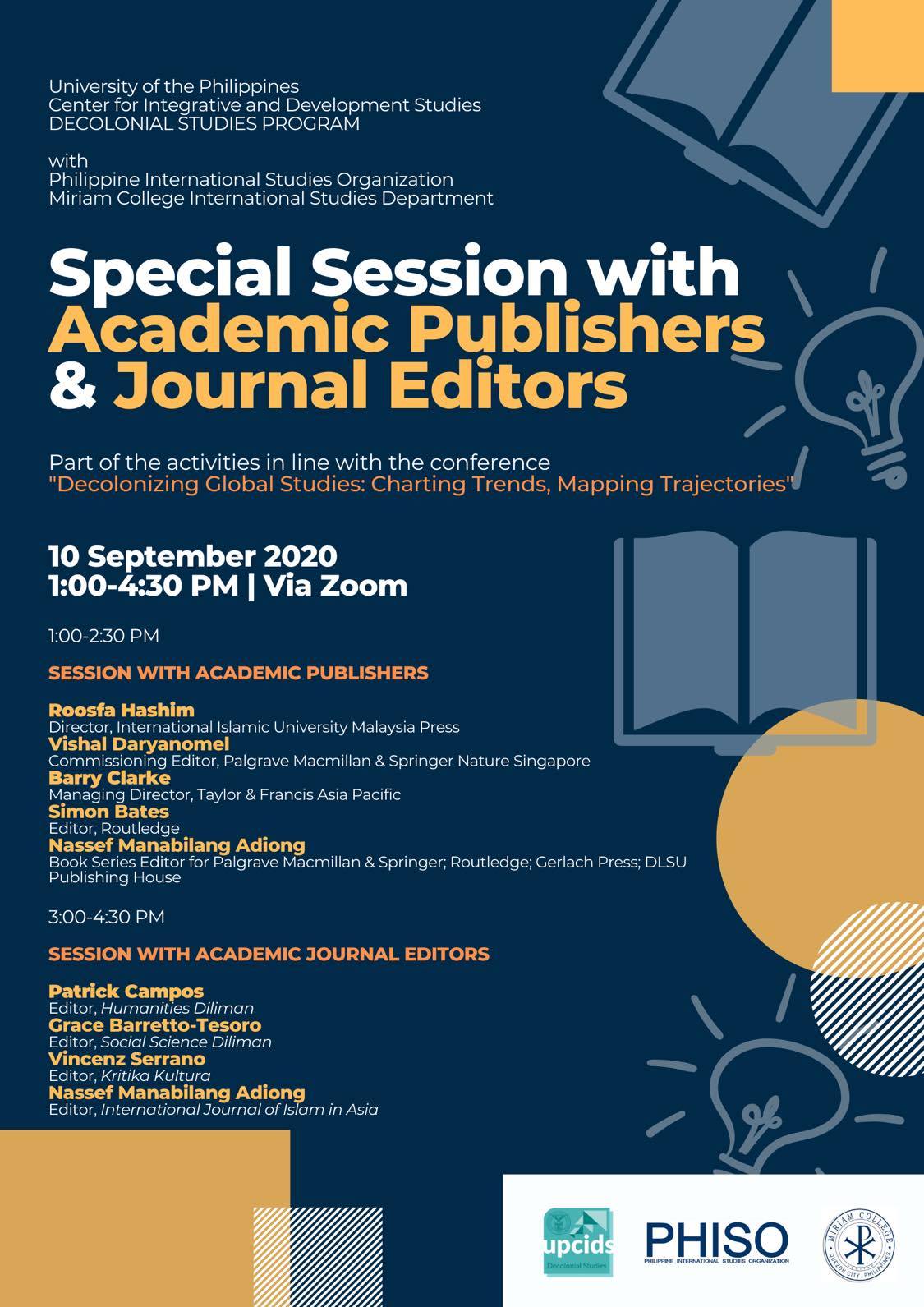
Hello everyone! As part of the activities we are preparing with the conference “Decolonizing Global Studies: Charting Trends, Mapping Trajectories,” we are also having a Special Session and Conversation with Academic Publishers and Academic Journal Editors this September 10, 2020, 1:00-4:30 PM. We asked our panelists to share something about the respective publishing house/press they are part and academic journals they are editing; share insights and tips for those who wish to publish their papers. Maybe we can also ask them about their experience and adjustment during this context of the global pandemic. Exciting discussions ahead, right?

Those who will be notified with the Zoom credentials for the conference will also receive the Zoom credentials for this special session.


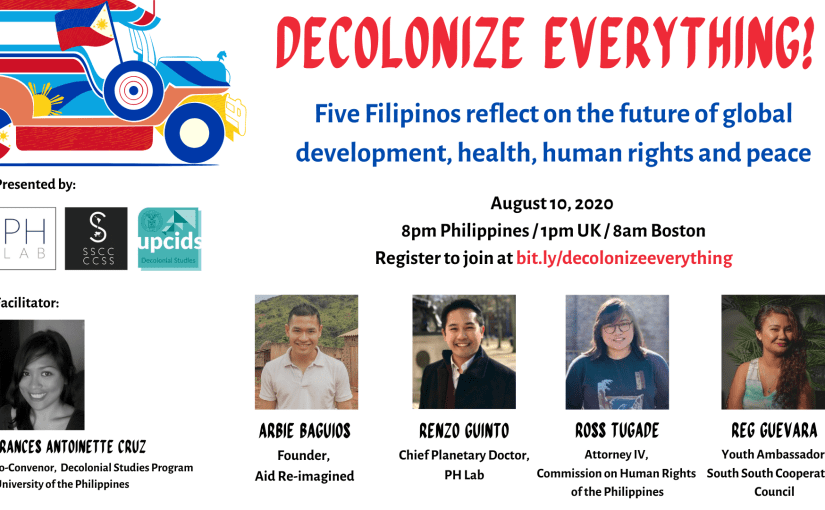
DECOLONIZE EVERYTHING!: Filipinos on the future of global development, health, human rights and peace

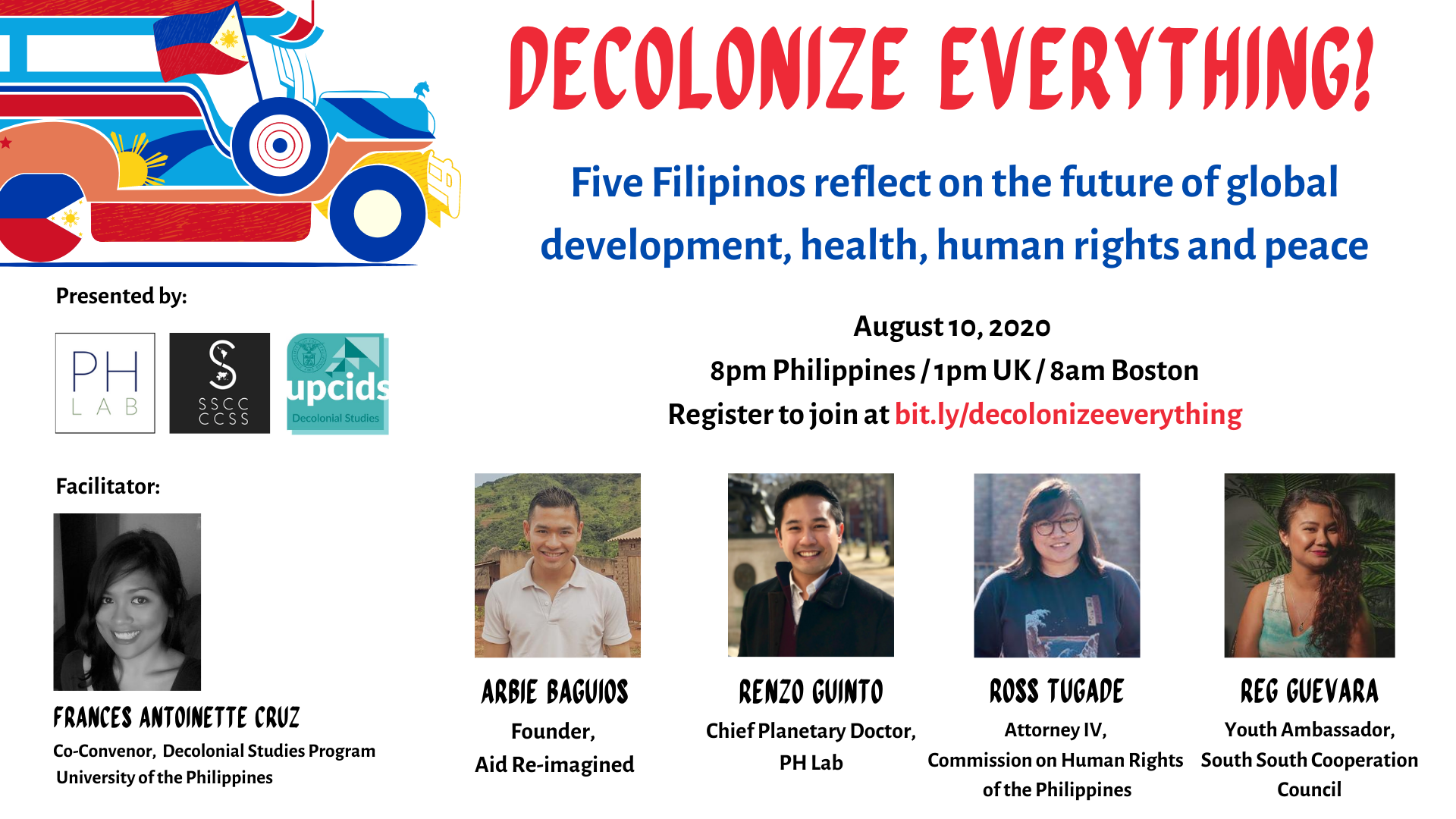
DECOLONIZE EVERYTHING!: Filipinos on the future of global development, health, human rights and peace
Date: 10 August, 1pm UK time / 8pm Philippines time / 6am US East Coast time

A global pandemic and mass protests all over the world – against all sorts of oppression, from racism in the Global North to authoritarianism in the Global South – has forced many of us into collective soul-searching of what our futures could look like. Four Filipinos who have experience working globally on issues that matter for the world as well as their own country offer their reflections on decolonizing our futures: in global development, health, human rights and peace. In Tagalog, “kwentuhan” means to tell each other stories, often in a lively fashion, where voices overlap and narratives interweave. Join us in this informal, irreverent kwentuhan, where we share stories from our personal and professional lives.

Click the video above.

Speakers:
Arbie Baguios is an international development and humanitarian aid professional, having worked for international organisations including ActionAid, Save the Children, UNICEF and the Red Cross. He is the founder of Aid Re-imagined, an initiative that helps usher the evolution of the aid sector towards justice and effectiveness.

Renzo Guinto is a public health physician working at the nexus of global health and sustainable development. He is the Chief Planetary Doctor of PH Lab, a glo-cal think-and-do tank for people and the planet, and has consulted for various organizations including the World Bank, World Health Organization, International Organization for Migration, and Philippine Department of Health.

Ross Tugade is a lawyer with the Commission on Human Rights, the constitutionally-created national human rights institution of the Philippines. She is also a published writer and researcher on the topics of human rights law and transitional justice.

Reg Guevara is a practitioner of regional peace and security, especially as it concerns ASEAN, and the Jewish-Arab conflict. Professionally, Regine has worked with multilateral institutions such as USAID, ASEAN, UN Women, UN Habitat, UNESCO, but is happier than ever working at the regional level for her peace advocacies with South-South Cooperation Council. Having lived in different cities around the world, she takes comfort in the mystic Rumi’s saying: “If light is in your heart, you will find your way home.”

Moderator:
Frances Antoinette Cruz is Assistant Professor at the College of Arts and Letters, University of the Philippines, Diliman, and co-convenor of the Decolonial Studies Program at the UP Center for Integrative and Development Studies.

Register here!
https://bit.ly/decolonizeeverything
Facebook event: https://www.facebook.com/events/741066846714330/

Manufacturing Terrorism in Africa: The Securitisation of South African Muslims

The firs book published under the Islam and Global Studies series, a collaborative project between Co-IRIS and Palgrave Macmillan.

Manufacturing Terrorism in Africa: The Securitisation of South African Muslims

Mohamed Natheem Hendricks

234042859This book uses Securitisation Theory to explore how Muslims have been constructed as a security issue in Africa after the 9/11 attacks in the United States. These attacks became the rationale for the US’s Global War on Terror (GWOT). The centrality of Africa as an arena to execute the GWOT is the focus of this book.

This book explores, particularly, how western-centred security discourses around Muslims has permeated South African security discourse in the post-apartheid period. It claims that the popular press and the local think-tank community were critical knowledge-sites that imported rather than interrogated debates which have underpinned policy-initiatives such as the GWOT.

Such theorisation seems contrary to the original architects of securitisation theory who maintain that issues become security concerns when institutional voices declare these as such. However, this book confirms that non-institutional voices have securitised the African Muslims by equating them with terrorism.

This book illustrates that such securitisation reproduces partisan knowledge that promote Western interests.


Dr Mohamed Natheem Hendricks, Senior Lecturer, Faculty of Education, University of the Western Cape, Cape Town, South Africa. His interest in security matters was sparked by debates related to Regional, Water and Human Security.