
With the purpose of ‘in aid of legislation,’ Dir. Dr Adiong’s research presentation focuses on two accounts: one is how Bangsamoro became an orientalist object targeted and subjected to Christian Filipino’s political elites’ ploy while the second is marked by political responses that the Muslim Moros partake in utilizing morality and decoloniality as their defensive neo-orientalist cards through a strategic regional legislation mechanism of their reputed autonomous parliament.
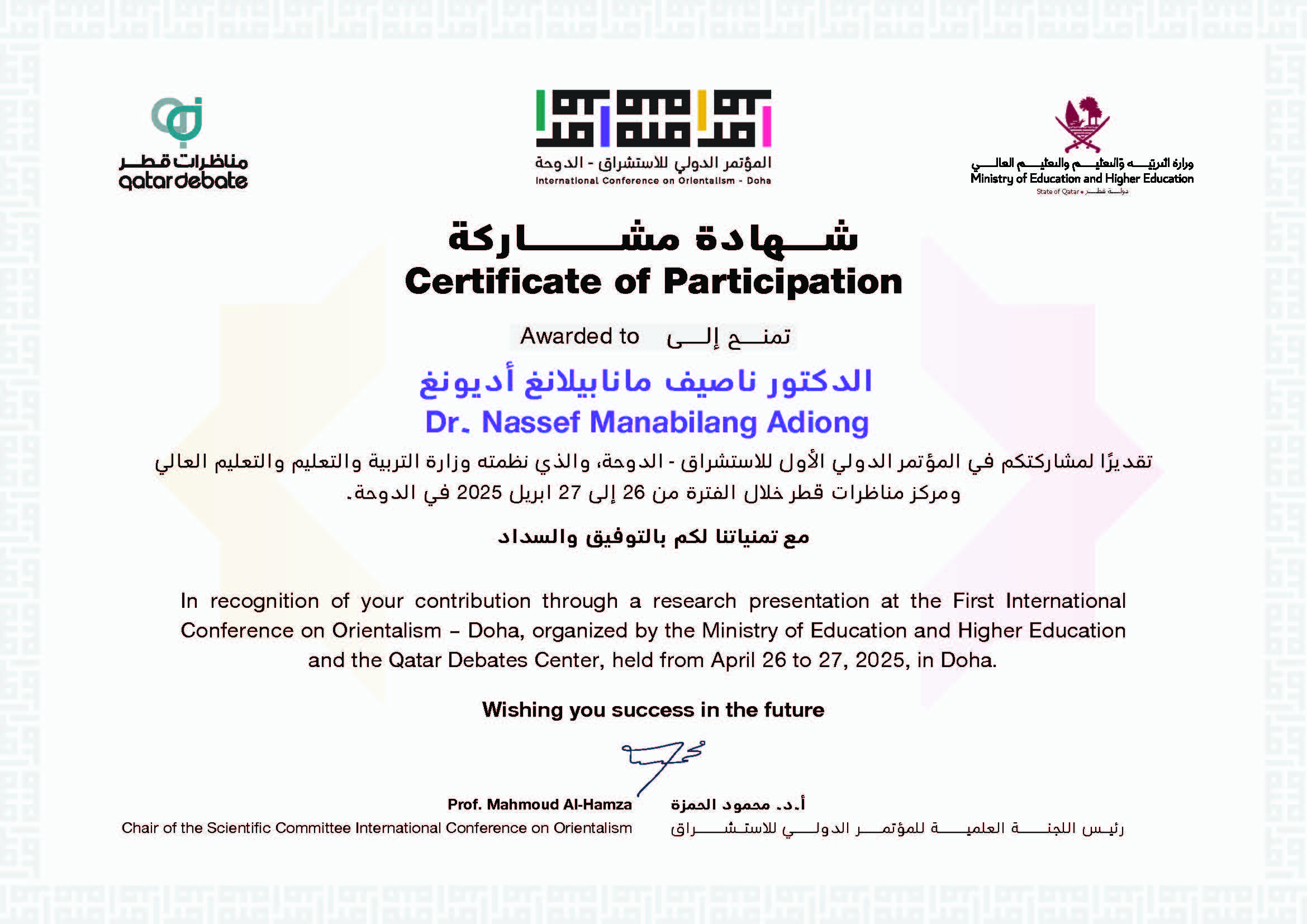
The research presentation, through conference network platforms, can shed light and provide legislative support to the following pending bills, namely, Bill no. 309 or protection of rights and welfare of community settlers, Bill no. 299 or Bangsamoro history towards autonomy museum, and Bill no. 31 or Bangsamoro Regional Institute for Higher Islamic Studies. It is without a doubt that this office supports Dir. Dr Adiong’s policy research endeavors in uplifting Bangsamoro lives through sound legislative advocacy by endorsing his request to participate in the Doha conference and gather data in aid of legislation.
Unbeknownst to a usual doxa rhetoric, Philippines is not a homogenous nation-state characterized by cultural or normative uniformity unlike their Asian counterparts of Malays, Chinese, Japanese, Koreans, and Thai descents who shared similitude of cultural traits, physical attributes, or civilizational values. Filipinos are culturally diverse with more than 195 spoken languages, 182 ethnolinguistic communities, majority (or 86% of its demography) are affiliated with the Christian faith represented by various Catholic and Protestant groups while a significant Muslim population exists in Southern Philippines alongside indigenous peoples (IPs) who settled across the country (Ileto 2001). There is a deep sense of favoring colonial experiences by Filipinos living in urban cities such as in Metro Manila, Cebu, or Davao as they have embraced Christianity from Spain and emulated the educational system, form of government, and whiteness culture of the US (Curaming 2009; Perez 2023). This “coloniality of being,” palpable and arguably claimed to be unique by those Christian Filipino urban dwellers, is the one thing that many Muslim Filipinos—particularly the Moro peoples—and IPs been struggling to accept and thus hereby resent until today (Alegre 2015; Mendoza 2023; Valencia 2022).
Borne from its self-conscious social and Islamic identity as Bangsamoro, these communities are composed of 13 ethnolinguistic Muslim groups where Meranaw, Maguindanaon, and Tausug dominate the entire representation. A cultural collectivity resulting from a struggle for self-rule and self-determination is deeply rooted in the historicity of the Muslims in the Philippines. Creating and organizing political representation is an orientalist strategy by Christian Filipinos’ political elites to address the age-old “Moro Problem,” also known as the “Mindanao Problem” or “Mindanao Conflict,” and purportedly gain peace dividends and capitalistic development. But the Bangsamoro response upends a certain decolonial dive of morality in which they called it “moral governance,” a process that denotes a system of order that is values-based and Islamically rooted. Islamic ethical philosophy is foundational to the Bangsamoro leadership framework that encompasses five immutable principles: Faith, Freedom, Moral Authority, Common Good, and Social Ethics (Adiong 2021).
Aside from the morality card as a response to Christian Filipino’s orientalist views and portrayals of Muslims in the Bangsamoro, the decolonial card is another response stemming from addressing colonial historical injustices by carving its own political trajectory through autonomy and resisting the replication of colonial-based politics. The discussion focuses on two accounts, one is how Bangsamoro became an orientalist object targeted and subjected to Christian Filipino’s political elites’ ploy and the second one is marked by political responses that the Muslim Moros partake in utilizing morality and decoloniality as their defensive neo-orientalist cards. And one approach that the Bangsamoro used is through regional legislation of their own autonomous parliament.

 Nassef Manabilang Adiong, PhD
You must be logged in to post a comment.